RSS
SIGN IN
From a 1956 summer workshop to systems that pass the bar exam — artificial intelligence has been promised, abandoned, reborn, and revolutionized across eight decades.
This isn't a comprehensive academic history. It's the minimum viable context you need to understand why AI is where it is today, and what patterns are likely to repeat.
Interactive Timeline — 1950 to Present
The first formal description of how neurons could compute logic — laying the theoretical foundation 80 years before ChatGPT.
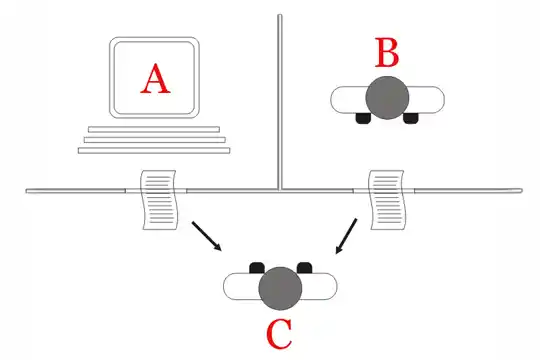
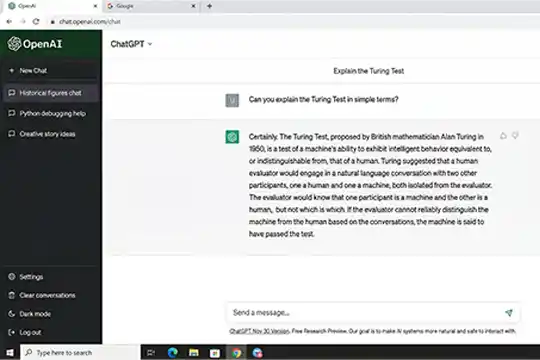
The paper that asked 'Can machines think?' and proposed the Imitation Game (later called the Turing Test) as a way to answer it.
John McCarthy, Marvin Minsky, Claude Shannon, and Nathaniel Rochester convene the conference that names the field. Their proposal predicted that 'every aspect of learning or any other feature of intelligence can in principle be so precisely described that a machine can be made to simulate it.' They expected it to take one summer.
The founders of AI were brilliant but wildly overconfident about timelines. This pattern repeats in every era.
The first hardware neural network. The New York Times reported it would 'be able to walk, talk, see, write, reproduce itself, and be conscious of its existence.' It could classify simple patterns.
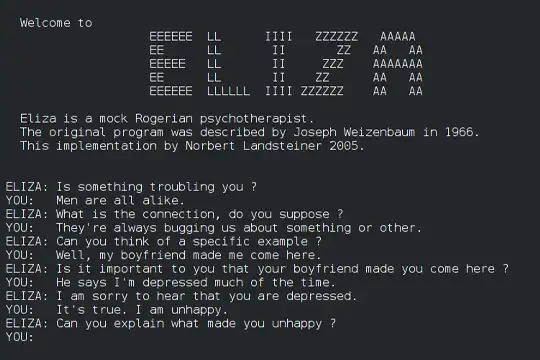
Joseph Weizenbaum's chatbot at MIT uses pattern matching to mimic a Rogerian therapist. Users become emotionally attached to it — the first demonstration that humans anthropomorphize AI.
The first robot to reason about its own actions. Shakey combined vision, movement, and problem-solving. It moved at about 2 meters per hour.
Early AI was funded by defense money and fueled by hype. When results didn't match promises, the money dried up.
British mathematician James Lighthill's report to the UK Science Research Council concludes that AI had failed to achieve its 'grandiose objectives.' Funding collapses across the UK.
DARPA slashes AI budgets. UK follows. Research continues in universities but the commercial promise evaporates.
AI winters happen when expectations outpace capabilities. The pattern: promise → fund → underdeliver → defund. It will happen again.
Rule-based systems like XCON (used by DEC to configure computers) prove that AI can deliver commercial value in narrow domains.
Rumelhart, Hinton, and Williams publish the paper that makes training multi-layer networks practical. This idea, ignored for 20 years, becomes the foundation of modern deep learning.
Expert systems proved AI could work in production. But they were brittle — every edge case needed a human-written rule.
Companies that spent millions on AI systems find them expensive to maintain and limited in scope. The specialized hardware market (Lisp machines) dies.
Researchers rebrand their work as 'machine learning,' 'computational intelligence,' or 'knowledge systems' to avoid the stigma.
When AI researchers renamed their field to avoid the label, it was the clearest signal of how badly overpromising had damaged credibility.
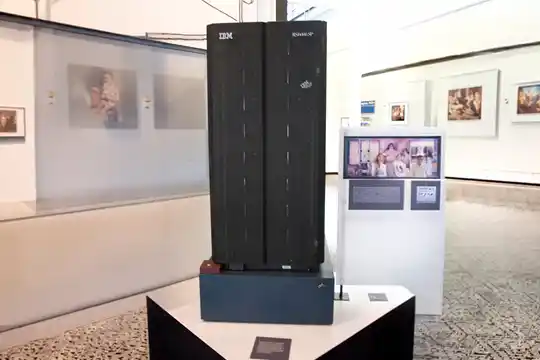
IBM's chess computer wins a six-game match against the world champion. It used brute-force search, not learning — but it proved machines could outperform humans at complex tasks.
Geoffrey Hinton's group at Toronto shows that deep neural networks can be trained layer by layer. This paper reignites the field that became modern AI.
IBM's Watson defeats champions Ken Jennings and Brad Rutter. The system combined NLP, knowledge retrieval, and probabilistic reasoning — a preview of what LLMs would do at scale.
The real progress happened when nobody was watching. Statistical methods and compute growth created the conditions for the coming explosion.
Krizhevsky, Sutskever, and Hinton's deep neural network crushes the competition in image recognition. This is the moment deep learning becomes undeniable.
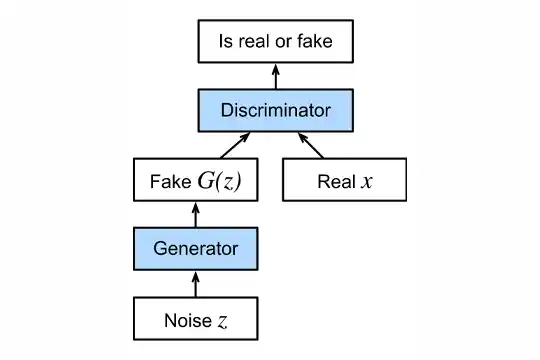
Ian Goodfellow invents Generative Adversarial Networks — two neural networks competing against each other to generate increasingly realistic images.
Google researchers publish the architecture that powers GPT, BERT, and every modern LLM. The key insight: attention mechanisms can replace recurrence entirely, enabling massive parallelization.
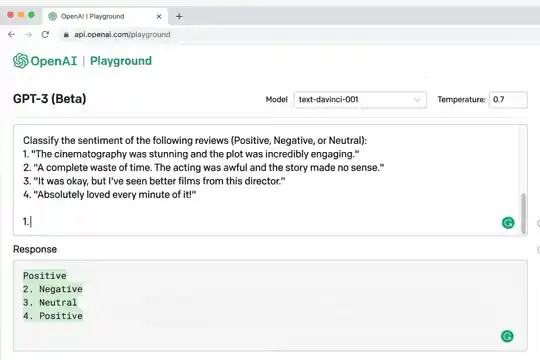
OpenAI's 175-billion parameter model shows that scale alone can produce capabilities nobody explicitly programmed — writing code, translating languages, and reasoning about novel problems.
The fastest-growing consumer application in history. AI goes from research curiosity to dinner table conversation overnight.
The Transformer paper is the most consequential publication in modern AI. Everything since 2017 — GPT, BERT, LLaMA, Claude — is a descendant of that architecture.
Models that see images, write code, reason through problems, and pass professional exams. The capability ceiling keeps rising.
Meta's LLaMA, Mistral, and others approach frontier performance at a fraction of the cost. The moat question becomes central.
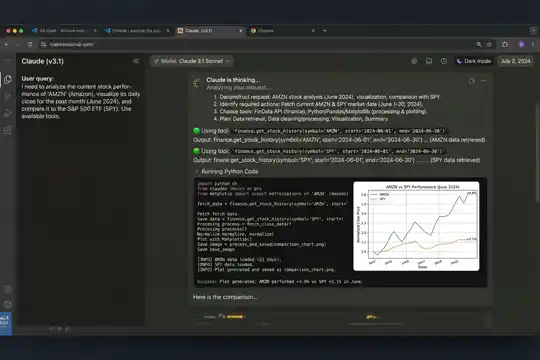
Autonomous systems that can browse the web, write and execute code, manage workflows, and operate tools with minimal human oversight.
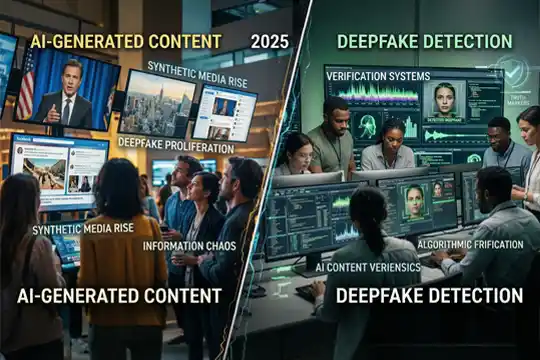
Regulatory frameworks are taking shape. AI-generated content exceeds human-created content online. The labor market is shifting. And nobody knows what happens next — which is why forecasting matters.
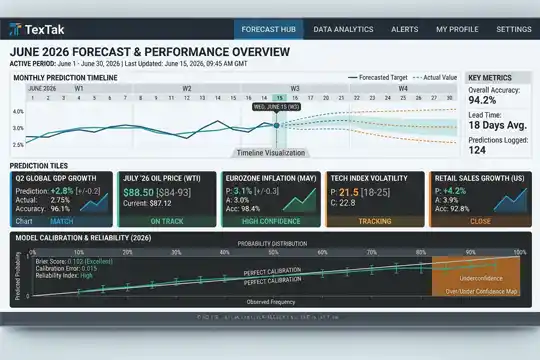
We're inside the inflection point. The pace of change makes prediction harder and more necessary at the same time. That's why textak exists.
Every AI era follows the same arc: breakthrough → hype → overinvestment → disappointment → quiet progress → next breakthrough. Understanding this cycle doesn't tell you what will happen, but it tells you what to watch for — and what to be skeptical of.
textak's forecast model tracks these patterns explicitly. When coverage of a technology follows the same trajectory as past hype cycles, that's a signal. When it diverges, that's a different signal.